Finding the Tragedy and the Humor in Chekhov: Kama Ginkas Stages “Rothschild’s Fiddle”
Fall 2003: Moscow New Generation Theatre Rehearsals
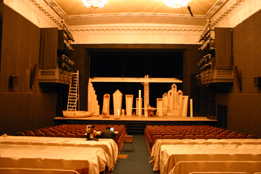
Rehearsal was not going well and everybody knew it. Finally, an actor broke off in mid-sentence
and sighed angrily, “I have no strength left.”
Kama Ginkas, directing his own adaptation of Anton Chekhov’s short story “Rothschild’s Fiddle” for a
January 15 world premiere at the Yale Repertory Theatre, didn’t bat an eyelash. From his standing
position in the center aisle of the theatre’s empty hall, he snatched up a small plastic bottle of water
and, without saying a word, fired it in a low arc over the actor’s head. Instinctively, the actor leaped
to catch it. Ginkas and the rest of the four-actor cast burst into laughter as the actor came back down
juggling the bottle spilling water all over him.
“Just as I thought,” Ginkas quipped. “You have plenty of energy!”
If anybody knows anything about energy, it is Ginkas, who at age 62 has put two serious heart attacks behind him while working a complex schedule of international productions and tours that would tax the reserves of a man half his age. Ginkas’s base is the Moscow New Generation Theatre, the co-producer of the Yale-bound “Rothschild’s Fiddle” which will be performed in Russian by Russian actors with English supertitles from January 15 to 31. But from August to November 2003 alone, Ginkas crisscrossed the globe touring and directing in the United States, Germany, France, Finland and Russia.
The Yale project rounds out a feverish year for Ginkas in the United States. In August he brought his famous production of “K.I. from ‘Crime’” – an adaptation of Fyodor Dostoevsky’s novel “Crime and Punishment” – to Bard College’s Fisher Center for the Performing Arts in upstate New York, drawing rave reviews from as far away as the West coast in the Los Angeles Times. In September, he unveiled his first American production at the American Repertory Theatre – an adaptation of Chekhov’s story “The Lady with the Lapdog.” In October, his book “Provoking Theater: Kama Ginkas Directs” was published by Smith and Kraus Publishers.
“Rothschild’s Fiddle” – telling the brief and tragic tale of the coffin-maker Yakov who is hardly more aware of his dying wife than he is of his loathing for the Jewish musician Rothschild with whom he occasionally performs at weddings – completes a trilogy almost sardonically titled “Life is Beautiful” that Ginkas has been working on since 1999. The other segments of the trilogy are “The Black Monk” and “The Lady with the Lapdog.”
Although Ginkas rose to prominence largely thanks to six extraordinary and challenging productions of Dostoevsky’s prose beginning in the late 1980s, it is Chekhov who has emerged as the director’s most frequent source for material. He first directed a biographical play about Chekhov in 1968 and adapted the story “Ward No. 6” for the Lilla Theater in Helsinki, Finland, in 1988. But after staging “The Seagull” in Helsinki in 1996, he repeatedly has come back to Chekhov in recent years. “Rothschild’s Fiddle” will be Ginkas’s ninth Chekhov production and, as his shows have done in the past, it will reveal a side of Chekhov that the literary tradition often fails to recognize.
Chekhov’s nature was a tragic one, Ginkas notes in “Provoking Theater,” filled with “paradoxes that existed inside him” and breaches “between others’ perceptions of him and his own perception of himself... Our impression of Chekhov is that he was a very proper person. But he was actually capable of being very explosive.”
Even more constant throughout the director’s 36-year career has been his penchant for staging prose adaptations. As he also discloses in “Provoking Theater,” his attraction to stories, letters and poetry as fodder for theater began in his school years in the 1950s and only grew stronger as time went on. “Formal restrictions provide a rich opportunity for dramatic development” Ginkas writes, because they provide a “tremendous source of tension.”
This reveals Ginkas’s strong sense of irony and paradox as well as expressing his attempt to bring multiple layers of nuance to his productions by blurring the lines that usually separate narrative, internal monologues and spoken dialogue. In shows like “Rothschild’s Fiddle,” characters not only converse, they pronounce descriptive text about themselves and others. Ginkas frequently mixes things even further by having his actors say one thing while doing something else entirely, and by having them break long sentences down into short, independent phrases that send meaning ricocheting in various directions before the final meaning is revealed.
During one Moscow rehearsal, Ginkas turned a simple dialogue into a mugging scene. But the last thing he wanted was for the actors to play it straight. “When you grab Rothschild by his collar and drag him around the stage,” Ginkas told his actor as he ran up on stage to demonstrate what he wanted, “you’re not attacking him. You don’t even notice you’re doing it. It just happens on its own. What you’re trying to do is talk to the audience and explain to them all of your frustrations. ‘No matter what I do, I suffer losses! My life is nothing but a pile of losses!’ That’s what you want, is to be understood. But somehow this guy’s collar ended up in your hand while you were doing it.”
Throughout the whole explanation, Ginkas dragged the actor playing Rothschild around the stage on his back, appealing plaintively and sincerely to the actor playing Yakov in the exact manner and tone of voice he was after. By the time he was done, he had elicited laughter from a handful of observers sitting in the hall because it illustrated so concisely the essence of what makes Ginkas unique – his ability to reveal humor in the most tragic of incidents.
The acting duo of Valery Barinov as Yakov and Igor Yasulovich as Rothschild brings together two of Moscow’s best-known actors of the stage and screen. Barinov, who is 57 years old and must beat up on Yasulovich several times in the course of the show – sometimes comically, sometimes not – is constantly hugging and apologizing to his partner before and after the rough physical scenes. Yasulovich, whose amazing agility makes one doubt seriously that he can be 62, scoffs and shrugs it off. “Just hit me,” he deadpans, turning his other cheek again.
As Moscow rehearsals progressed in November and December, the depth and scope of Ginkas’s aims in “Rothschild’s Fiddle” began to be revealed. The themes of the developing show were so rich and dense, it seemed to pack several productions into one.
Some will see it as a profound and provocative exploration of the nature of anti-Semitism. As a miraculous child survivor of the Holocaust whose mother used to tell him, “Kama, Hitler came to kill you,” Ginkas certainly intended this message to ring clearly. Yet he has never been, and likely never will be, an artist of social or moral issues. He is interested in the intricate psychology of the human being, in what makes a person tick, what makes a person violent, comical and sympathetic all in one moment.
In this light, “Rothschild’s Fiddle” may emerge as a play that focuses on the fragility and frequent futility of the human experience, one that is fraught with error, confusion, ignorance and misunderstanding and then is over in a flash. If from one angle Yakov appears insensitive and even racist, from another he is as much a victim of life’s inequities as anyone else. Indeed, Ginkas and Barinov are expending enormous effort to reveal this character’s fundamental vulnerability.
But perhaps it is in this very effort, the work going into the production, that the primary theme of Ginkas’s “Rothschild’s Fiddle” lies. Yakov is a craftsman, an artist of sorts. His tools – his saw, his ax, his hammer, his workbench – are what make his life bearable and the product of his labor – the coffins he fashions – are what give it meaning, for better or for worse.
Coming back to the mugging scene another day, Ginkas wanted to get a firsthand feel for what happens when Barinov’s Yakov drags Yasulovich’s Rothschild around the stage. He bounded up on stage, squeezed into Yasulovich’s coat and ordered Barinov to toss him down and haul him around on his backside. After gingerly following orders for a few seconds, Barinov released his director who got up briskly and without help. “Basically, I used to be able to do more,” Ginkas admitted.
And a few moments later, he added, “I’m not sure where the tragedy is and where the humor is in this scene.”
John Freedman is the theater critic of The Moscow Times and co-author, with Kama Ginkas, of Provoking Theater: Kama Ginkas Directs.